

Cole Young is that dude
Even if he’s one in a long line of guys who weren’t

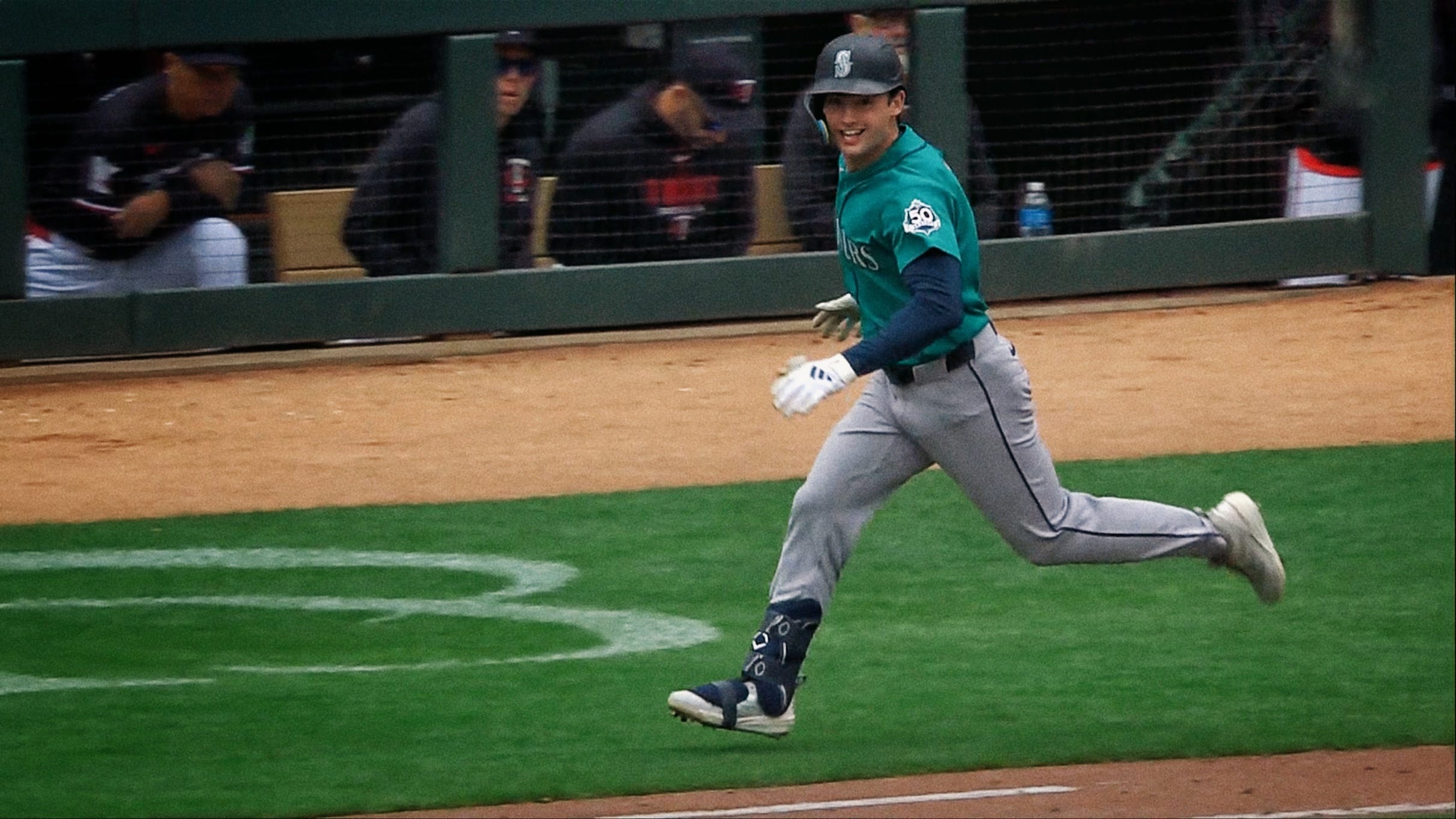
Let me tell you about the 2010 Seattle Mariners.
It was a team we were led to believe, after the acquisition of Cliff Lee, had legitimate title aspirations. Why we trailed right along like ducklings after their mother despite an Opening Day lineup that looked like this one, I don’t know.
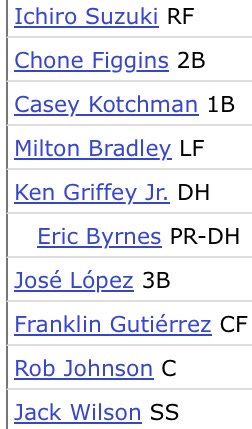
Optimism and the mania of spring in Seattle has that effect, I guess. Same for trading for the best player available all winter, as the M’s did for Lee.
The optimism was dampened a bit when the lefty ace went down with an abdominal strain halfway through spring training, suffered by colliding with Chris Snyder of the Diamondbacks while backing up a play at the plate.
How Mariners.
Lee didn’t actually go down there and then, after the first-inning collision, I’ll add. His outing wasn’t cut short until he was ejected in the third for throwing a pitch at Snyder’s head.
I’m honestly just learning that part, which, good times. Cliff Lee, what a character.
When the diagnosis came down he’d be out for most of the first month, the talk across town was how the Mariners just needed to get through April at .500 or close, just until Lee got back.
In an April 28th game at Kauffman Stadium, started by Ryan Rowland-Smith and opposed by the Royals’ Gil Meche, a Rob Johnson sac fly in the 8th brought home Milton Bradley and gave the M’s a 6-5 lead. David Aardsma closed it out.
The win got them to 11-11. Their next game, the last of April, would be Cliff Lee’s first start in a Mariners uniform.
They did it.
Lee dominated, Eric Byrnes missed the bunt on a suicide squeeze and the rest—Byrnes riding out of the building on an adult trike and Cliff traded to the Rangers in the middle of a miserable season for us and dominant one for him—is history.
So whenever the Mariners go .500 or close in April, I think of that team.
There are no lessons there—just that it’s funny how much standards have changed, how much more talented this team is than that one.
The 2026 Mariners, despite the sluggish start, have everything laid out in front of them and, perhaps, enough talent to accomplish it.
The 2010 were so bad. They very quickly (8-19 in May) had fans thinking about next year and the presumed arrival of homegrown second baseman with an all-fields lefty swing.
How’s that for a transition, finally, out of an overly extended lede?
Let me say right now that when I compare Cole Young to the players I’m about to compare him to, I do it out of love.
These aren’t the guys I was watching when I first fell in love with the Mariners, just the guys I was watching a decade deep into an absolute grind of a marriage.
They’re the highlights, I swear.
On highlights, here’s one that used to be staple for me. Even as I pull it up on YouTube now, the red progress bar is almost to the end, right at the curtain call.
For awkward and unathletic dudes like me, second basemen have serious appeal because that’s where we played when we were little. If they let us out of the corner outfield positions.
The guys in the show are not that but they’re sometimes have that aura—or possibly the lack thereof?
Almost all these guys—same as it is with Cole Young now—are former shortstops. Hell, when Brad Miller played shortstop, you could see on every throw he was a future former shortstop.
And they let him replace Brendan Ryan at the position!
They didn’t let Nick Franklin do that. I guess they needed to see a few more weeks, which was the gap between Franklin and Miller’s 2013 call-ups, of what was a 44 wRC+ from Ryan.
Different times, man. They’re a lot different, but the cool thing about baseball is how easy it is to look across time.
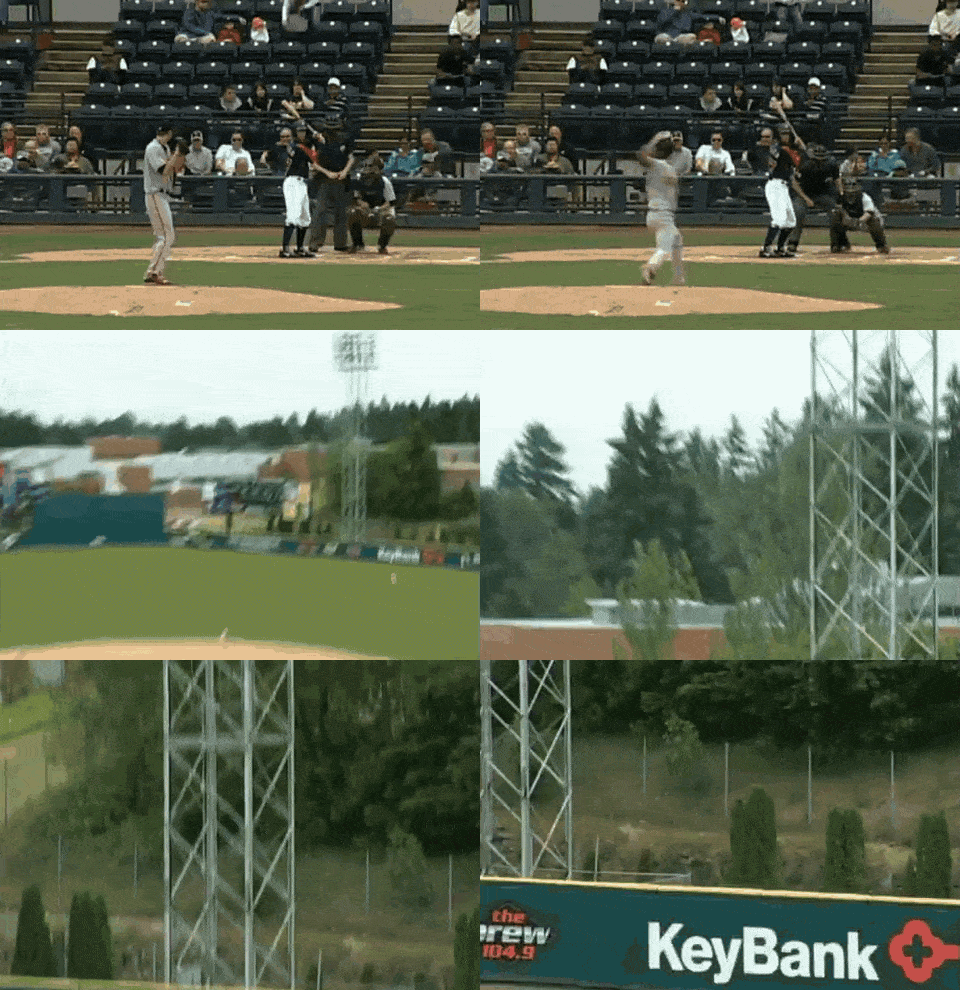
When Colt Emerson banged one halfway up the light tower in Tacoma last year, @MILBMariners of course sharing the video, I thought immediately of Brad Miller doing the same his entire professional career ago.
The 2013 season was when my now-wife and I first moved back to Seattle from our shared time in Missoula. We actually drove from there to San Francisco for Opening Day in Oakland, before we moved.
After we did, settling into a one-bedroom in Ballard, we hosted her family in that spot later in the summer—her parents and her brother and his girlfriend all crammed in because her dad’s Twins were playing the M’s and that’s just when you visit your family sometimes. When your ball club is in their town.
We snuck in some good seats early behind the road dugout early and saw Nick Franklin hit two home runs in a 6-4 M’s win.
Franklin was just 22 that year, same age Cole Young is now.
Nick Franklin washed out of the Majors by 27. He was completely out of baseball at 28.
Cole Young is not Nick Franklin.
Probably.
• • •
There are 19 minor leaguers on MLB Pipeline’s Top 100 Prospects list who are younger than Cole Young.
It’s so important to understand that it’s not just about what Young is doing, but the age he’s doing it at.
Jerry Dipoto had this great line to Adam Jude in a piece for the Seattle Times:
“To get to the level he did at the age he did … those players generally stay around a long time,” Dipoto said recently. “Those are guys that you look up and they had 10-, 12-, 15-year careers and did really special things. And I think we’re going to look up and that’s what it’s going to be for Cole.”
Of course, when I say “doing it” as I did above, we’re talking primarily about the last month—even if he did have good stretches and help the team win some games last year.
For posterity, the line early is .286/.357/.420 for a 126 wRC+ and 0.9 fWAR. Just look at that triple-slash, it screams quality second baseman.
Right now, you’re going to see a lot of mentions of Cole Young’s bWAR (or Baseball Reference’s WAR, not FanGraphs’). And the reason why is that it’s higher—because before every game the talented and hardworking folks in Mariners Baseball Information prepare what are called the “game notes,” a packet flush with stats and usually the most favorable ones.
Those go on TV and the radio and in newspapers. That’s just how it works.
I’m not going to use bWAR primarily because I’m a fWAR guy and I’ve always been an fWAR guy but also because bWAR uses Defensive Runs Saved for defense and DRS is outlier-level crazy about Cole Young right now. I’ll wait for MLB’s Statcast-powered Outs Above Average to catch up, even if bWAR and DRS now have Young as the fourth-best position player in the game.
Alright, you know what, for Ss and Gs and because Baseball Reference doesn’t have an easily accessible way to link directly to this one leaderboard, here’s the list.
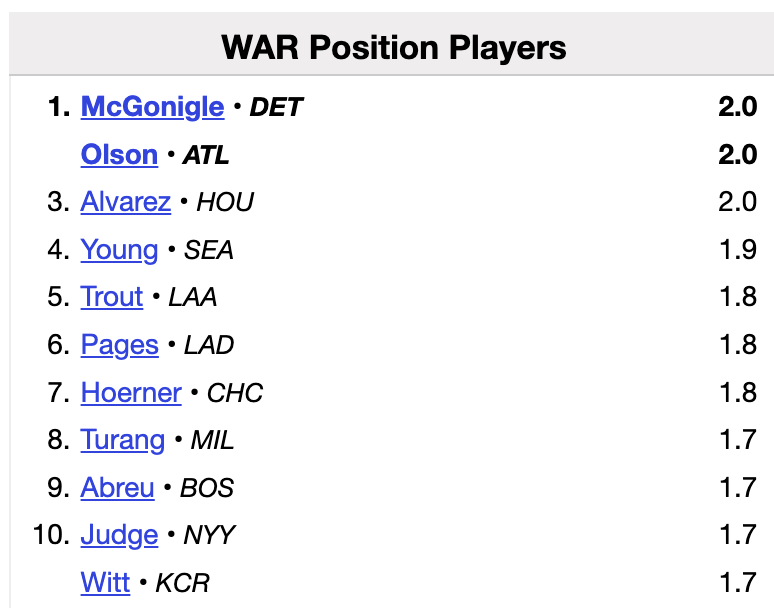
Still, the point remains, bWAR isn’t a statistic I tend to care too much about— particularly when a guy’s figure is noteworthy because of a month’s worth of DRS data.
But there are other noteworthy stats I do care about. Let’s hit ‘em and call it a post, huh?
Shannon Drayer reported early in spring that being able to hit the fastball was a big point of emphasis from the Mariners to Young after his rookie year, a campaign in which he struggled mightily against the heater.
An update:
Young vs. four-seam fastballs in 2025: .189/.291/.256 for a 71 wRC+
Young vs. four-seam fastballs so far in 2026: .270/.372/.432 for a 141 wRC+
Last year, Young had four total extra-base hits against the pitch. He’s already matched that mark in 2026.
The other big split to keep an eye on, the one you watch with every young player in today’s über-optimized game, is simple platoons.
Young vs. lefties in 2025: .220/.313/.322 for a 89 wRC+
Young vs. lefties so far in 2026: .324/.351/.588 for a 161 wRC+
I do not think Cole Young will finish the year with a wRC+ over 160 vs. southpaws. But progress is progress, even if it is early.
Finally, while there are any number of reasons for the kid’s hot start to make you grin, from the possibility of him undoing the unfulfilled promise of Ackley and Miller and Franklin or maybe just because you think he’s handsome, there’s a reason it is so particularly salient.
Here’s how he’s hit based on the situation:
Low leverage: .278/.328/.278 for a 81 wRC+
Medium leverage: .195/.306/.317 for a 85 wRC+
High leverage: .529/.579/1.118 for a 367 wRC+
When the game is on the line, 2026 Cole Young has 123 points of wRC+ on 2002 Barry Bonds.
Basically, here, if you took Barry Bonds during his very best offensive season and added regular 2026 Cole Young, you would get 2026 High Leverage Cole Young.
Insane stuff.
Or, less dorky, you get polished and competitive at-bats when you need them most. You get, on Wednesday, multiple key knocks after battling relentlessly with two strikes.
In re-watching the broadcast a bit for this post, some commentary from Angie Mentink stood out: she said that, in those spots, you’re not just looking to go up there and have a good at-bat—you go up there and do what has to be done.
With runners on second and third with one out in the ninth and a 2-2 count, team down a run, he had to put the ball in play. Is it subotimal to get fooled on a splitter way off the plate away? Sure.
But he did what had to be done.
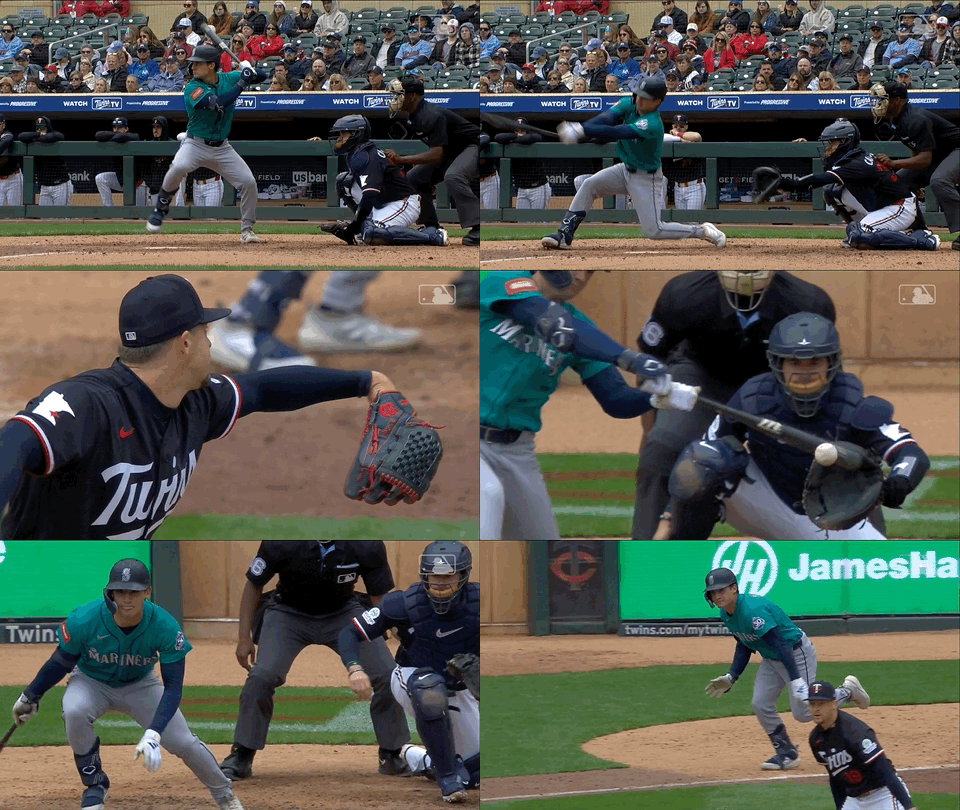
Process is great and Young’s is supposedly much improved—but it’s a results business. And he is getting results.
Cole Young won the Mariners a ballgame and gave us another memorable moment in the adolescence of what could be a long career for a beloved homegrown player.
Regardless of what the future holds—though right now it does look as bright as Young’s GQ smile—this is such a fun time to root for a dude.
This is what it’s all about, the whole story.
And right now it’s just beginning to get good.