

Just because the Mariners ignore free agency doesn’t mean we have to
The top of the free agent hitter class is literally all the Mariners’ weakest positions. We should talk about this more.

A lack of imagination is one of the biggest problems facing the world today. Or maybe it’s better described as pessimism? Low demands? It’s hard to frame exactly.
“A better world is possible” is what folks often say, preemptively responding to blowback from suggesting dramatic improvement from the status quo.
Yes, we know why things are the way they are. But it doesn’t mean they have to be that way. Or that we can’t talk about the way they are and how they should be much better.
So yeah. This is my blog and we’re going to do the occasional post on how the Mariners could just go spend money to acquire more good players if they wanted to.
Let’s take a look at where they stand as we head into the new year and offseason’s final few furlongs before spring training. Specifically, let’s look at where they’re most wobbly.
Drawing on FanGraphs’ Depth Charts and their associated projections, here are the Mariners’ weakest positions for the 2026 season. No real surprises.
Second base: 2.5 fWAR
Third base: 2.2 fWAR
Left field: 2.1 fWAR
Right field: 1.8 fWAR
Designated hitter: 1.6 fWAR
For those being the Mariners’ worst positions, they’re really not that bad—especially at the two spots we assume the club is most likely eying an upgrade. That is, generally, how you end up sitting in the top five in projected WAR for 2026.
That top end of the table is going to shift, though, with all the talent still on the board. Not to mention, these are the wins that are toughest to come by. That’s what the whole old win curve is about.
It can be very expensive to go from 88 to 90 to 92 to 96 to 100 wins. Much more expensive than going from like 78 to 81 to 83.
It’s a price the Mariners, so far, have been reticent to pay. And we all expect that to continue. Because it will continue.
Meanwhile, I want to go back to some projections, specifically projections for the best position players available on the open market. Here are those players, their position(s), their 2026 projected fWAR and their crowdsourced projected AAV for 2026 and beyond.
Kyle Tucker, LF/RF, 4.4 fWAR, $35M AAV
Bo Bichette, SS/2B/3B, 4.0 fWAR, $27M AAV
Alex Bregman, 3B, 4.0 fWAR, $31M AAV
The three best free agents available play literally the Mariners’ three biggest positions of need.
And there is no expectation for the Mariners to pursue, let alone sign, any of these players.
It’s insane! Bananas foster!
I’m not going to make this as fleshed-out as last year’s version of this post but it remains immensely frustrating the Mariners apparently will never run a top ten payroll under this ownership group. If they weren’t and aren’t doing it for this window and these teams, they aren’t doing it ever.
The contextual level that spending has sunk to is, apparently, what to expect until there’s a new crew backing the operation.
For a kid who fell in love with the M’s in the early 2000s when they were among the game’s uppermost echelon and spent like it, too—well, it sucks.
/Jarvis, pull up the chart.
Here, once again, is the Mariners’ Opening Day payroll rank going back to the beginning of the century.
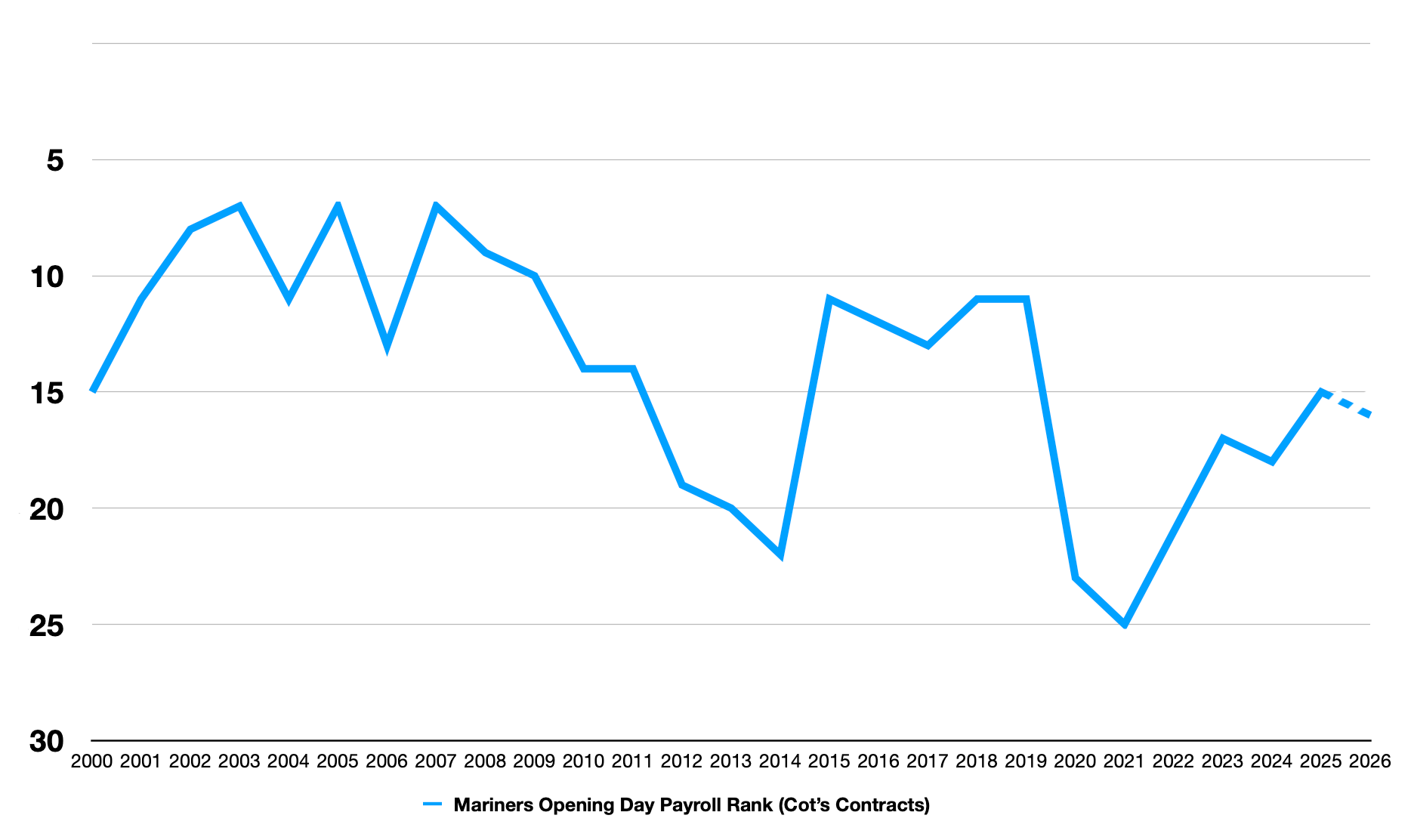
Again, I used Cot’s because it has the legacy data. For 2026, I have what they’re in for now but we can expect—I would think—at least another $10 million or so, taking them from roughly $158 million to a possible $168 million.
Per FanGraphs, Arizona is currently at $168 million and 14th in payroll. Detroit is 15th with $164 million in 2026 outlays.
Should the Mariners indeed start their 2026 with a payroll about where 2025 ended up, that $168 million figure, they’d once again be right in the middle of the pack.
Most likely, they will once again end up below their market size (13th). They will certainly be outside the top 10, they’ll be way below their franchise high-water mark (7th) and even further back of the lowest luxury tax threshold.
The Mariners have $10 to $15 million left to spend because that’s what John Stanton, Chris Larson and company said they could spend. And that’s all there is to it.
It’s a business after all, folks say.
They spend a whole year talking about the 50th anniversary of regular-old businesses? Not so much.
The Mariners are a community institution.
And the community deserves to see more of an investment in the roster after its own investment in the organization.
Remember the price of those playoff tickets? Oohwee.
If the Mariners decided now, finally, to allocate resources on the level of the sport’s true contenders—at least the top 10—they’d have another $40 million to spend.
They could sign any one of the three players noted above, including Kyle Tucker—who’d bolster a corner outfield crop that has an aging Randy Arozarena and unproven Dominic Canzone in the top two spots on the depth chart.
Or they could drop Bregman at third over the possible Ben Williamson/Colt Emerson platoon. They could play Bichette there, too—or at second, gasp, blocking Cole Young.
The Mariners would have to spend at least another $70 million this offseason to rise to their highest-ever payroll rank, 7th, a spot currently occupied by the Houston Astros.
They could sign any two of Tucker and Bregman and Bichette and, should Houston not spend more this offseason (unlikely), still be behind their biggest threat in the division.
The Mariners don’t have to live like this.
We don’t have to be chill with it, either.
Even when they’re as good as they’ve ever been, there’s a path for the Mariners to be even better.
And ownership should take it. Or find someone who can.
Go M’s.
I would like to see the math on how much the Mariners made on playoff ticket sales. I would guess that they pocketed close to 135 million just on 3 World Series games that never happened.
Trade an aging Randy, use that $11M and a couple of prospects and sign Tucker. Please!